Digital Billboards
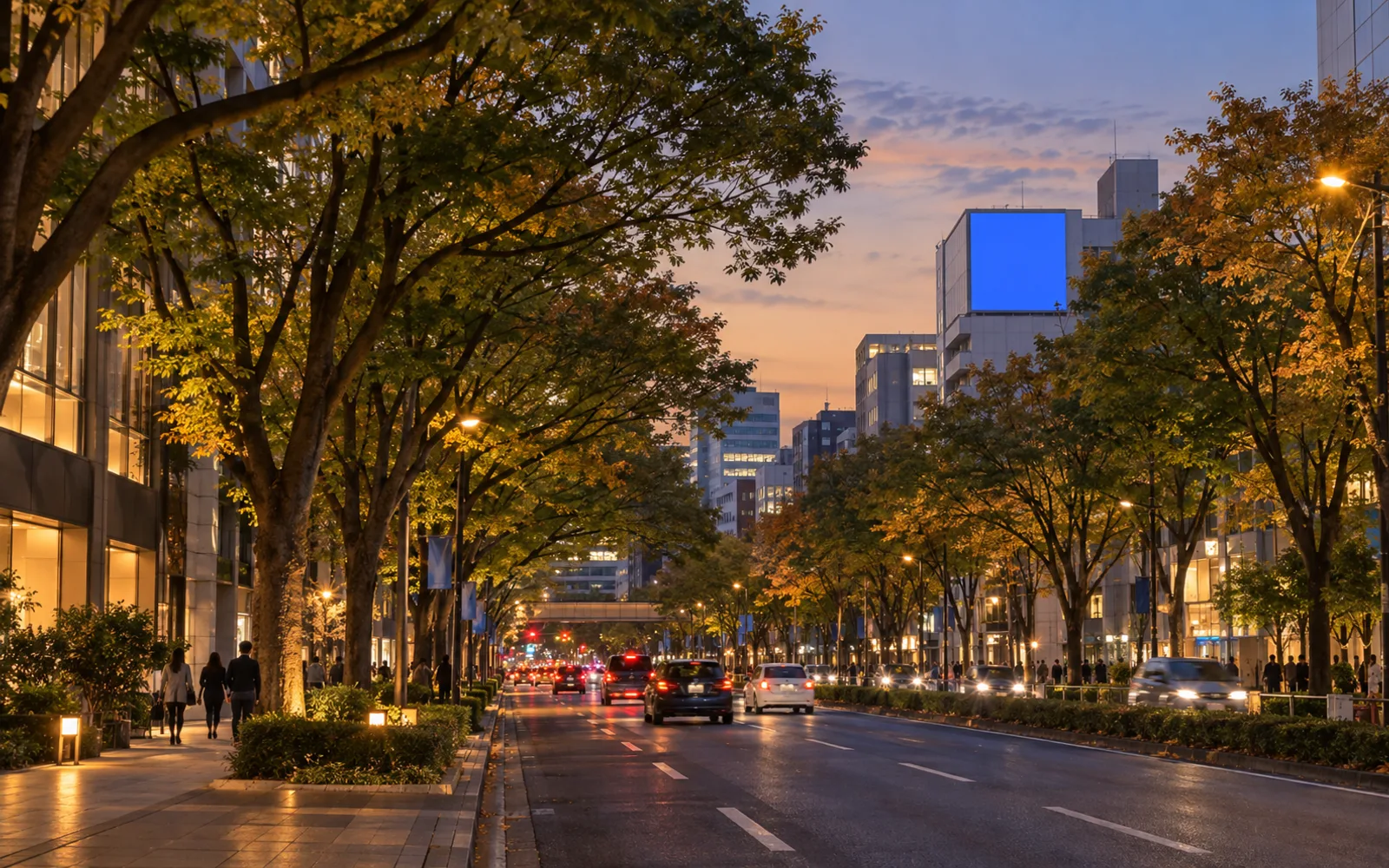
Large-format LED screens at Japan’s highest-traffic intersections and station exits.
Available in Tokyo · Yokohama · Osaka · Nagoya
BILLBOARDS · DOOH · TRANSIT · JAPAN
JAPAN OOH helps global brands plan, buy and run billboard, digital and transit advertising campaigns across Japan.
From digital billboards and transit advertising to station media, taxi ads and airport placements, we provide end-to-end campaign support from our team in Japan.
Solutions
Japan runs on trains, stations and dense city centres. These are the formats that put a brand in front of that movement.
Large-format LED screens at Japan’s highest-traffic intersections and station exits.
Available in Tokyo · Yokohama · Osaka · Nagoya
Screen networks bought across locations, with dayparting and mid-flight changes.
Available in Tokyo · Yokohama · Osaka · Nagoya
Posters, digital and full takeovers where millions of commuters change trains.
Available in Tokyo · Yokohama · Osaka · Nagoya
Inside the carriage, where the average commute gives you real attention.
Available in Tokyo · Yokohama · Osaka · Nagoya
The rail network Japanese cities run on — trains, subways, stations and buses.
Available in Tokyo · Yokohama · Osaka · Nagoya
In-cab video reaching business audiences between meetings.
Available in Tokyo · Yokohama · Osaka · Nagoya
Screens inside the retail, office and commercial spaces where people spend time.
Available in Tokyo · Yokohama · Osaka · Nagoya
Reaching inbound and outbound travellers at Japan’s main gateways.
Available in Tokyo · Osaka · Nagoya · Fukuoka
Traditional large-format outdoor sites on the routes into and through the city.
Available in Tokyo · Yokohama · Osaka · Nagoya
Wrapping an entire facade when the building itself becomes the campaign.
Available in Tokyo · Yokohama · Osaka
Eye-level media on the pavement, where people are already standing still.
Available in Tokyo · Yokohama · Osaka · Nagoya
Media availability varies by location and campaign period, and is confirmed at the time of booking.
Why Japan
Few markets concentrate this many people into this little space, moving on foot and by rail every day.
Greater Tokyo alone is home to roughly 37 million people. Campaigns reach metropolitan-scale audiences within a small geographic footprint.
Rail is the default way to move through Japanese cities. Commuters pass the same stations twice a day, five days a week, which builds frequency fast.
Districts such as Shibuya, Shinjuku and Umeda are walked rather than driven, so ads are seen at close range and at a standstill.
Flagship digital sites in Japan are maintained to a high standard, and appearing on them signals that a brand is investing in the market.
Large-format digital sites cluster around major intersections and station exits, where sightlines are long and dwell time is high.
OOH is public and unskippable. For a brand entering Japan, being visible in the city is often what makes it feel established.
Media
The placements we can plan within this category.
Plan Your Japan Campaign
Locations
Tokyo and Yokohama anchor most campaigns, with full planning and booking support in seven more markets across Japan.
The densest OOH market in Japan, and the one most campaigns start with.
Shibuya · Shinjuku · Ginza
Japan’s second-largest city by population, and the natural extension of a Tokyo campaign.
Minato Mirai · Yokohama Station · Sakuragicho
Western Japan’s commercial centre, with a louder, more visual advertising culture.
Umeda · Namba · Shinsaibashi
Japan’s manufacturing heartland, and an efficient third market.
Nagoya Station · Sakae · Kanayama
Kyushu’s gateway city — compact, young, and unusually walkable.
Tenjin · Hakata · Nakasu
Hokkaido’s centre, with a strongly seasonal audience pattern.
Odori · Susukino · Sapporo Station
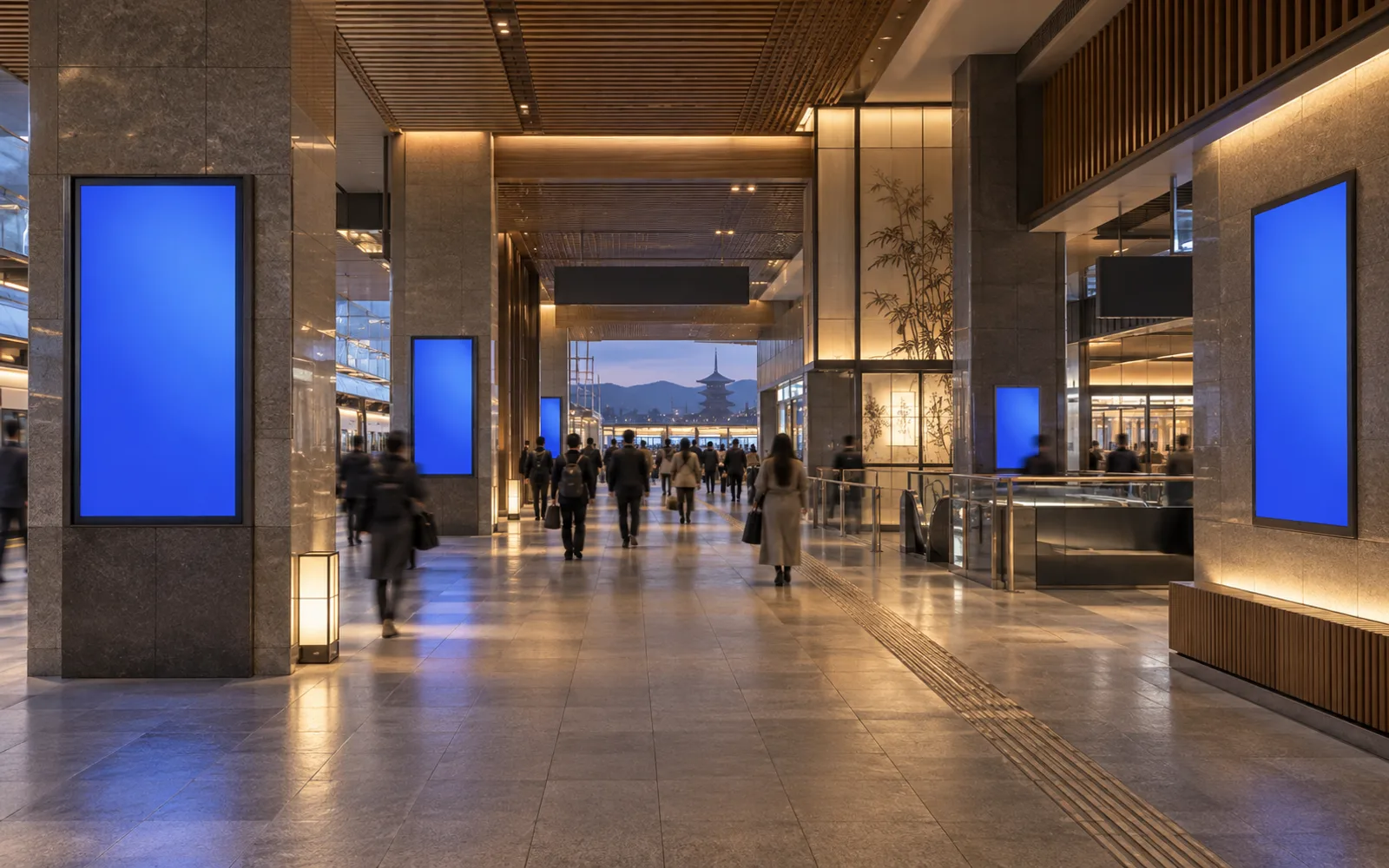
A heritage city where advertising runs through stations, not skylines.
Kyoto Station · Shijo-Karasuma · Shijo-Kawaramachi
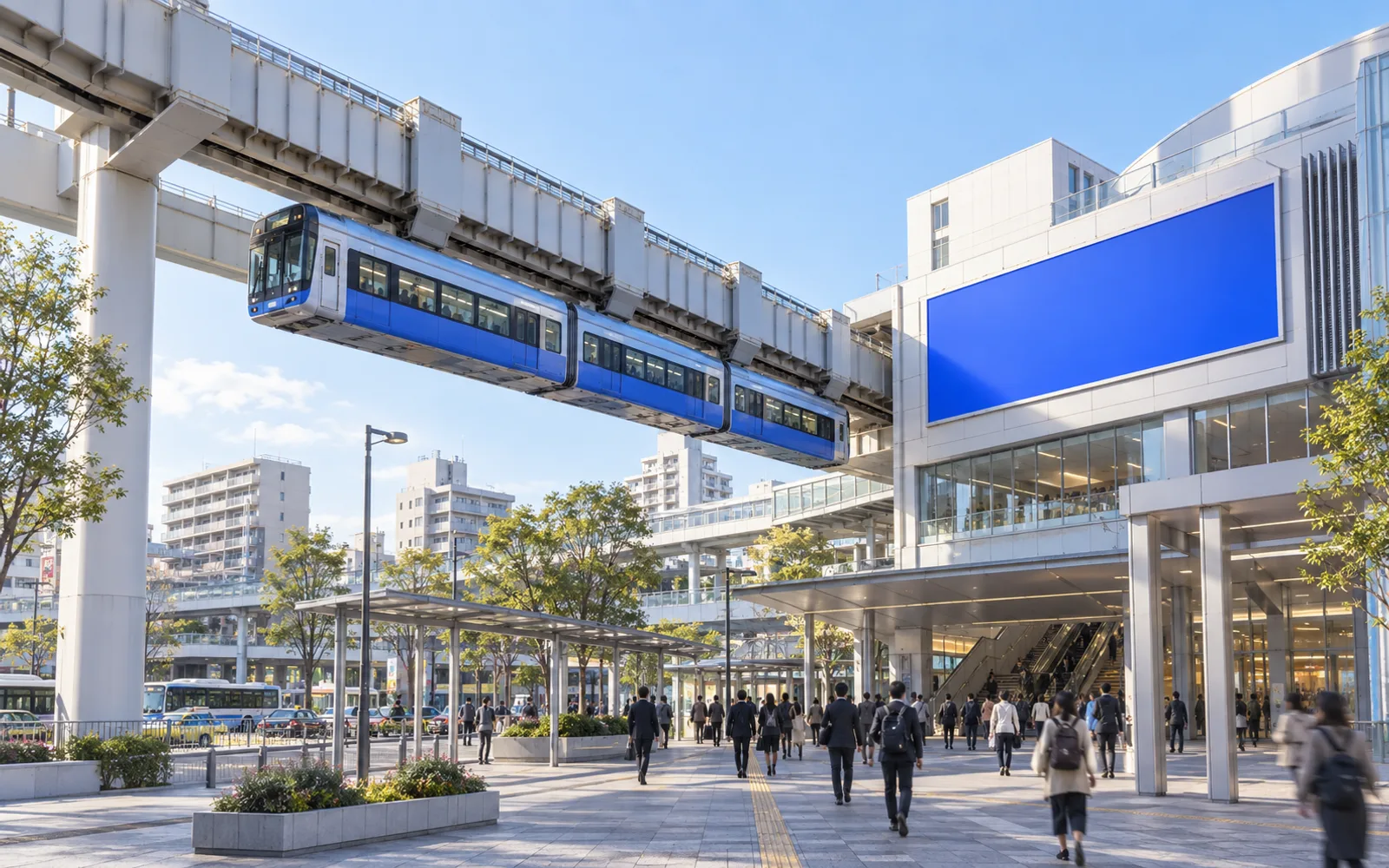
Tokyo’s eastern commuter belt, with an airport and an exhibition district.
Chiba Station · Makuhari · Funabashi
The largest city in Tohoku and the gateway to northeast Japan.
Sendai Station · Ichibancho · Kokubuncho
Why JAPAN OOH
Most of our clients are planning a Japanese campaign from outside Japan. The service is shaped around that.
Our team works in Japan, in Japanese, with the media owners and vendors your campaign depends on.
Knowing which station exit, which screen and which two-week slot actually performs is the difference between a placement and a campaign.
One point of contact from the first conversation through to the post-campaign report.
OOH rarely runs alone. We can extend the same campaign into digital, social, influencer and PR through CoDigital.
Japanese OOH is booked through a network of media owners and vendors, most of whom work in Japanese and on Japanese processes. JAPAN OOH sits between you and that network: we translate the brief, source availability, handle the coordination, and come back to you with a plan you can approve.
The operational work between a signed plan and a live campaign is where overseas campaigns usually stall. We handle it.
Every media owner publishes its own specifications and its own review process. We make sure your files clear both.
How It Works
Seven stages. You are involved in the ones that matter and shielded from the rest.
We start with your objective, target audience, city, budget and timing. A 30-minute conversation is usually enough.
We write the brief back to you in a single document, so both sides are working from the same definition of success.
We check live availability and build a shortlist of formats and locations that fit the objective and the budget.
You receive a media plan with formats, locations, periods, costs and the reasoning behind each choice.
Once approved, we confirm inventory, handle the paperwork with media owners and manage creative specifications and submission.
Your campaign goes live. We verify placements and share proof of posting where the media owner provides it.
After the campaign we deliver a report covering delivery, placement documentation and available audience data.
Tell us the objective, the city and roughly what you have to spend. We will come back with media options that fit.
Use Cases
The objective shapes the format. These are the briefs we see most often.
Build recognition in a market where your name is new, across high-traffic city centres.
Concentrate visibility into the launch window with digital formats you can update mid-flight.
Drive footfall to a new location using media within walking distance of the door.
Reach the right city in the weeks before the date, with transit media doing the reminding.
Reach outbound Japanese travellers at stations, airports and city centres.
Pair transit and station media with digital retargeting to move people from seeing to installing.
Support a film, series, game or artist release with large-format sites in entertainment districts.
Reach candidates on their commute, in the business districts where they already work.
Establish presence when entering Japan, so the market sees the brand before it sees the product.
Integrated Marketing
Out-of-home does its best work when the rest of the campaign is pointed the same way.
JAPAN OOH is operated by CoDigital, Inc., a Japanese digital marketing company. When a campaign needs more than media placement, the same team can extend it across these channels.
Typical pattern: OOH carries the visibility, digital and social retarget the audience it created, and influencer or PR gives it a reason to be talked about.
Campaign Examples
Three common campaign shapes, and how the formats fit together.
These are illustrative campaign structures, not past client results. Client case studies will be published here once approved for release.
Tokyo
A brand arriving in Japan concentrates spend on large-format digital sites in Shibuya and Shinjuku for two weeks, supported by station digital in the surrounding lines and taxi video to reach business audiences between meetings.
Yokohama
A launch built around Minato Mirai and Yokohama Station: DOOH screens carry the launch creative, station media holds the message through the commute, and in-train digital extends frequency across the Tokyo–Yokohama corridor.
Osaka
Broad reach across Osaka using roadside billboards on main approaches, transit advertising on the subway network, and digital signage in commercial facilities around Umeda and Namba.
Pricing
The honest answer is that it depends — but here is what it depends on.
OOH advertising costs vary depending on location, media type, campaign period and availability. A two-week digital package in a regional city and a flagship site in central Tokyo are different orders of magnitude. Tell us your budget and campaign goals, and we will recommend suitable media options rather than quote a number that does not fit.
Tell us your budgetWe do not publish fixed rate cards. Prices are quoted per campaign against confirmed availability, because that is the only figure that is actually true on the day you book.
Read the article How Much Does Billboard Advertising in Japan Cost?
FAQ
The questions overseas advertisers ask us most.
OOH (out-of-home) advertising in Japan covers any advertising seen outside the home: digital billboards, station and in-train media, taxi screens, airport placements, building wraps and street-level signage. Because Japanese cities are dense and rail-based, OOH reaches a very large share of the urban population daily — particularly through the station and train network.
Outdoor Advertising in Japan: A Guide for International Brands
Costs vary widely by location, format, campaign period and availability. A regional digital package and a flagship site in central Tokyo are not comparable. JAPAN OOH quotes per campaign against confirmed availability rather than publishing a fixed rate card. Share your budget range and objective and we will propose media that fits it.
Yes. JAPAN OOH helps overseas brands plan and coordinate OOH campaigns in Japan without requiring an in-house Japanese marketing team or a Japanese subsidiary. We handle the Japanese-language media coordination, booking and creative submission on your behalf.
Outdoor Advertising in Japan: A Guide for International Brands
Yes. Alongside Tokyo we plan and book media in Yokohama, Osaka, Nagoya, Fukuoka, Sapporo, Kyoto, Chiba and Sendai, and can arrange nationwide campaigns spanning several cities. Format availability differs by city, and we will tell you where a market is thinner before you commit budget to it.
Yes. Yokohama is one of our primary markets. We plan campaigns around Minato Mirai, Yokohama Station, Sakuragicho and Shin-Yokohama, covering digital billboards, station media, in-train advertising and commercial-facility signage. Yokohama is often paired with Tokyo to extend a campaign across the same commuter corridor.
Yes. We arrange station posters, station digital signage, wall and large-format placements, station takeovers, and in-train media including door ads, hanging ads, interior panels, train wraps and in-car digital screens. Availability and lead times differ by operator and by station.
Yes. Digital billboards and DOOH are our most requested formats. We book large-format screens in districts such as Shibuya, Shinjuku, Umeda and Minato Mirai, either as fixed placements or as network buys across multiple screens with dayparting.
Yes — this is a core part of the service. Japanese media owners generally work in Japanese and on their own processes and deadlines. JAPAN OOH manages that correspondence, the booking documentation and the submission schedule, and reports back to you.
Yes. We check creative against each media owner’s technical specifications, coordinate file preparation and resupply, support the submission and review process, and can coordinate Japanese-language adaptation of your existing creative.
As a general guide, start two to three months before the intended launch. Premium sites and station packages are frequently booked out well in advance, and creative review adds time after the booking is confirmed. Shorter timelines are sometimes possible with digital formats, depending on availability.
Yes. JAPAN OOH is operated by CoDigital, Inc., a Japanese digital marketing company, so the same campaign can extend into search, social, video, influencer marketing and PR. A common structure is OOH for visibility with digital retargeting against the same audience and geography.
There is no single entry point — it depends on the city, the format and the period. Rather than quote a threshold that may not apply to your campaign, we ask for a budget range in the enquiry form and propose the media that genuinely fits it, including telling you when a budget is not yet workable for a given format.
Send an enquiry through the form on this page with your objective, target city, budget range and timing. We will come back with questions if anything is unclear, then prepare a media plan covering formats, locations, periods and costs.
Yes. We work as the Japanese execution partner for agencies and media buyers based overseas, handling local planning, booking and coordination while the agency retains the client relationship. Reporting can be prepared in a format you can pass to your client.
Contact
Tell us the objective, the city and roughly what you have to spend. We will come back with media options that fit.
You do not need a finished brief to get in touch. A rough objective and a budget range is enough for us to start proposing formats.
We reply within one Japanese business day.
Thank you — your enquiry has been sent.
We will reply within one Japanese business day.